Showing posts with label SEZ. Show all posts

Wednesday, October 8, 2008

82% farmers against Reliance SEZ land acquisition: Samiti

Press Trust of India

Alibaug, Oct 6: Most affected farmers and landowners of the proposed Reliance Special Economic Zone (SEZ) in neighbouring Raigad district are against the project, the organisation spearheading the agitation against the SEZ has claimed.Though the government has not yet declared any result on the referendum conducted last month, SEZ Sangharsh Samiti chief Mr ND Patil declared the result on the “basis of information sought by it”.
“About 82 per cent of farmers are not in favour of SEZ,” Mr Patil said in a Press conference here.
“The Samiti has decided to wait till 21 October since all the farmers are busy with rice crop and then decide the further line of action,” he said.
The government has not yet come out with the result of the referendum, an official from the collectorate told PTI.
About 18,000 landowners and farmers from 22 villages voted on the issue on 21 September. Farmers of these villages had opposed the project stating theirs was arable land due to the Hetawane dam located in the area and as such could not be acquired for the SEZ.
But the confusion about the referendum is still not over with chief minister Mr Vilasrao Deshmukh's statement made last week, that the poll conducted in Raigad was not a referendum and no such referendum will be conducted for any SEZ in future.
Source: The Statesman, 7 October 2008

Saturday, January 27, 2007

Zone of conflict


Previously we discussed how government promotes Special Economic Zone to maximize the profit of MNCs and comprador capitalists. Mumbai SEZ is part of that ongoing programme. The following article published in Frontline discussed this particular SEZ in detail.

Zone of conflict

DIONNE BUNSHA
in Mumbai

The Maha Mumbai Special Economic Zone project of Reliance faces resistance from residents of villages which may be acquired for it.

CHIRNER village has a history of resistance. On September 25, 1930, local people staged a "jungle satyagraha" here against the British when they were denied their right to collect firewood. Nine people were killed in police firing, including a mamlatdar (district official) who refused to give orders to fire. Dr. B.R. Ambedkar fought the case for the satyagrahis.

Once again, Chirner is witnessing a fight. But this time, the residents are not confronting the British empire. They are fighting against an Indian company - Mukesh Dhirubhai Ambani's Reliance Industries Limited.

What the company wants to set up is not very different from the East India Company's trading zones. Reliance wants to develop a Special Economic Zone (SEZ) in Chirner. An SEZ is an enclave where no taxes are collected, there are no labour laws and there is no local government - on land taken for a pittance. That is the Maha Mumbai SEZ project.

It will be Mumbai's satellite city spread over 35,000 acres (1 acre is 0.4 hectare) - one-third the size of the metropolis. Since the government has cleared Reliance's request for it to be the special planning authority, the company will have complete control over the development of the entire area. With land prices shooting up, undeveloped areas outside the city are the next big booty for real estate developers. Before anyone could lay their hands on it, Reliance has gobbled up the entire stretch from Navi Mumbai to Dharamtar creek. And the government is acting as its real estate agent. It will acquire 45 villages for the Reliance project.

"Money comes and goes. Land never leaves a person's hand. That's why we won't let them take our land. We are self-sufficient," says Praful Kharpatil, a local leader. "It won't create employment for us. The SEZ will employ only highly educated people. They will make us security guards or peons, and won't let us enter the gates. After all the development that has already taken place here, graduates are working as loaders in the Jawaharlal Nehru Port Trust (JNPT) container warehouses. So isn't it better to have your own land?"

The government has issued notifications for land acquisition. But people have no clue how much they will get for their land. Reliance has been trying to buy up land at Rs.3 lakhs to Rs.4 lakhs an acre (0.40 hectares), without much luck. So local hearsay is that they will not pay a penny more while getting the government to acquire the land. The market rate is anywhere between Rs.20 lakhs and Rs.40 lakhs an acre, depending on the location and quality of the land. Reliance just bought 450 hectares of undeveloped land at Rs.26 lakhs to Rs.40 lakhs an acre in Navi Mumbai from the City Industrial Development Corporation (CIDCO). Some parts of the failed satellite township that CIDCO planned in Navi Mumbai will also be part of the SEZ.

"Why should we sell for less? Let them pay the market rate. The land value will soon be much higher than even Rs.40 lakh when the new airport is built here and the Nhava Sheva-Sewri bridge will make it only a 30-minute drive into central Mumbai," said D.K. Patil, executive president of the Maha Mumbai Shetkari Sangharsh Samiti, a coalition of several groups that has been formed to challenge unfair land acquisitions. The value of land here is high also because of its proximity to the JNPT port.

District officials say that local market rates are only Rs.1.28 lakhs an acre for agricultural land and Rs.10.32 lakhs for non-agricultural land - a gross underestimation. The government will decide the rate later. It will take a year before it announces the guidelines and the rate at which property will be acquired, said D.S. Jhagade, the District Collector of Raigad. The land acquisition law also says that while fixing compensation the state must take into consideration the value of the land after it is developed, but this is not being considered. This time, Reliance has chosen to operate outside the market. Companies that swear by `market forces' run back to the state for subsidies and concessions.

The process of acquiring land as laid out in the outdated Land Acquisition Act, 1894, is illogical. Once the notification is issued, public objections are invited and after they are heard, the government decides on the compensation package. But how can people accept or reject land acquisition until they know what deal they are going to get? On what basis can they file objections without knowing what price is offered to them? "We are not against development. But what kind? We haven't been told anything. If they are truly interested in giving us a fair deal, whey don't they sit across the table and talk to us?" D.K. Patil said.

"It's up to the government to acquire the land, so they will negotiate," explained Dilip Chaware, spokesperson for the Maha Mumbai SEZ project. "Village homes in the gaothan (residential) areas will not be acquired, only the farm lands. People will get all the benefits of better infrastructure. We will train the youth for job skills. They can grow with the SEZ. Anyway, the land is not productive and people were not employed," he said.

SEZs are being hyped as our pathway to prosperity. Maha Mumbai is supposed to be the largest private SEZ in the world. "The company would not have been able to buy such a large chunk of land in the open market, so the government had to acquire the land for them. This is what happens when planners are more excited about a project than people," said a government official.

Most of those whose land will be acquired are Agris and Kolis, traditional farmers and fisherfolk. "We were ousted from Mumbai and Navi Mumbai. Where are we to go? Can you see us anywhere in this picture?" asked D.K. Patil, pointing to the glossy SEZ brochure cover with skyscrapers, an airplane and a golfer. "We won't get jobs here. There's an Agri saying: Mumbai tumchi, Bhaandi ghasa aamchi [Mumbai is yours, but you will wash our dishes]. That's all they will make us do."

After learning the hard way through the CIDCO acquisitions, the local people are demanding more than just a job assurance. "We should get a share in the business. We don't want to be serving but owning businesses. They can train us to manage businesses like warehousing on our properties," said Jeevan Gavan, a Zilla Parishad member from Uran. Others are asking for a share of Reliance's lease rent or shares in the company so that they have a source of regular income.

In the 1980s, CIDCO acquired land from 95 villages displacing about 30,000 families to develop Navi Mumbai. Then too, villagers fought for a better deal. After an agitation in which two persons were killed in police firing, the government agreed to increase the rate from Rs.15,000 an acre to Rs.30,000, and agreed to return 12.5 per cent of the developed land back to the owner. It also promised jobs to every family.

"The state didn't deliver on any of its assurances. We got only Rs.15,000. Very few got jobs. They didn't give back 12.5 per cent of the land. They had also promised salt-pan workers 40 square metres. We are still fighting for that land. They have left us as beggars," said Dharma Patil (69), a salt worker from Agroli village in Navi Mumbai.

There were not as many takers for the Navi Mumbai project as was expected. Several plots of land were lying unused. That is why CIDCO has sold a lot of it to Reliance and has become a 26 per cent partner in the Navi Mumbai part of the SEZ. "We want industry but not without labour laws or job security. We don't want bonded labour," says Sanjay Thakur, a leader of the Communist Party of India (Marxist).

An SEZ is a duty-free enclave considered foreign territory for trade and financial purposes. If you buy goods from an SEZ, you have to pay import duties. Under the newly formed SEZ Act, companies in the zone are granted huge concessions in customs duties, sales tax and even income tax. Mukesh Ambani has even got the permission to be the special planning authority for the SEZ. His company will plan the development and create infrastructure for the area, including water and power supply. There will be no local government. A development commissioner will govern it.

"It will be a new city, not just an SEZ, and will generate 25 lakh jobs," Chaware claimed. "There will be one million residents and exports are estimated at $15 billion in 10 years. We are investing $5 million in infrastructure, including a dam and a power plant." The government has cleared 26 SEZs across the country, hoping to emulate those in China. At present there are eight SEZs functioning in India.


But neither Reliance nor the government was willing to give any cost-benefit analysis of the project. What are the costs and losses - economic, social and environmental? Are the gains worth it?

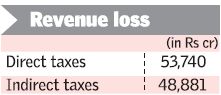
An internal assessment of the Finance Ministry has estimated that the country will forgo about Rs.90,000 crores in direct and indirect taxes over the next four years because of the SEZs across the country.

A large part of this loss is because export units that are now paying tax will shift to these areas ("Why the SEZ policy needs a rethink", The Hindu Business Line, May 26). Many wonder whether the pipedreams will actually translate into large-scale investment or is it just a real estate grab? The SEZ model is now being questioned even in China because it creates huge economic disparities rather than broad-based development.

That is the brand of `progress' that the people of Chirner are also challenging. "Our vegetables and fruits get the best price in the market. Why should we sell our land?" asks Kharpatil. "We fought the British. Now we will fight our own government." Chirner village is preparing for round two.

Link

Wednesday, January 10, 2007

SEZ: Policy for Plunder

SEZ: Policy for Plunder


Buddha and other state governments become crazy with special economic zone (SEZ). Mainstream media have been portraying SEZ as panacea for Indian economy. They claim that SEZ will bring up enormous job opportunities and in turn eradicate poverty.

We know in all over India for SEZs different state governments has been planning to acquire lakhs of acres of land, most of which is farmland. Naturally people do protest and place like Nandigram the people’s resistance becomes too difficult to crackdown even after bloodshed.

A section of intellectuals and middleclass believe that this resistance is due to the unawareness of people and SEZ can change the face of India. They oppose people’s resistance and for them whoever oppose SEZ and land acquisition is anti-development and their actual aim is to keep people poor.

Let’s consider the whole issue.

A policy was introduced on 1.4.2000 for setting up of Special Economic Zones (SEZ) in the country with a view to provide an internationally competitive and hassle free environment for exports (1). But, why it is ‘special’? It is special, because industries in SEZ will have some definite advantages. They will be under huge tax exemptions. And apart from production, within SEZ township could be built up. There will be full authority to provide services like water, electricity, security, restaurants, recreation centers etc. on commercial lines (1). That means government will do everything to secure their maximum profit. But, this will cost really high price. For a period of four years, 2006-07 to 2009-10, the total revenue loss due to tax exemption to SEZ will be more than 1 lakh crore (3). It simply means that we, the Indian people have to subsidize this much amount directly to these big companies who will develop SEZs and set up industries over there. It simply shows that government (state or central) encourages SEZs to protect the interest of big companies and corporations. Since, in the existing laws, they are bound to pay taxes (it is different issue, how much they actually pay) and there could have been nation wide protest if government changes these laws, they have just made a new policy on April 1, 2000 to keep big companies out of taxation. And this is what they call as SEZ.


Mainstream media and the advocates of SEZs argue that the boom of job opportunities in SEZs will actually compensate this revenue loss. Crores of job then eradicate poverty from India and at the end poor Indian people will be benefited.

Nowadays the advocates of globalization are talking too much about job opportunities. Cleverly what they hide is the fact that in industries there is an increasing trend of recruiting contractual labour workers. They are the main work force now. They don’t have any professional security and most of the cases extremely underpaid. They have to work more than eight hours a day. If it continues then how increasing job opportunities will help? It simply cannot be. If somebody has a job, but he earns the salary not enough to provide minimum calorie to his family then it doesn’t help.


In this context it is important to understand that companies make profit out of the labour. It is the essence of capitalist mode of production, in other word capitalist exploitation. In the initial stage of capitalism the wage of a labour was enough to sustain his family. The average profit was enough to satisfy the capitalists. But, capitalists cannot make profit unless they sell the commodities. That means capitalism needs market. As capitalism grows, due to its exploitation it excludes more and more people from its market, which in turn makes more and difficult to ensure the profit.

With time capitalism has been entered its moribund stage, the imperialism, where monopoly dominates; centralization of capital becomes the main trend. After Second World War it has been reached such a phase when it requires maximum profit.

Maximum profit means maximum exploitation. Thanks to imperialist exploitation (actually plunder) that most of the people of the world become so poor that they are actually excluded from imperialist market. So imperialism simply doesn’t care for them. Different mainstream parties, government and mainstream media as the faithful agent of imperialism, are only concerned how their “bosses” can ensure the maximum profit.

This is the reason they dare to advocate SEZs and acquisition of farmland fully knowing that it is nothing to do any good for common poor Indian people, who are marginalized in the imperialist market. They are so faithful to serve the interest of imperialism and their comprador big Indian capitalists that they even don’t feel ashamed to falsify the fact: SEZs and acquisition of land will eradicate poverty from India. . Actually it is absurd to protect the interest of both imperialism (and big comprador capitalists) and common people at the same time.

There are intellectuals who also support the stand of government. They have been trying their level best to make us believe that it is the way of development as exactly same thing had happened during the industrial revolution in Europe. Industrialization requires land, but finally who will be evicted can end up with better opportunity in industry.

These advocates of imperialist plunder use to forget that the stage of capitalism right now is absolutely different from the days of industrial revolution in Europe. In those days the law of capitalism was the “law of surplus value”; which means that although capitalists used to make profit, although it used to exploit, it used to give workers the wages sufficient to sustain his livelihood. In contrast, at the phase of total collapse of imperialism, when it is driven by the securing maximum profit, means maximum exploitation, it cannot assure the minimum calorie to the majority of population. Two contexts are qualitatively different. Today, even in western world, workers have been loosing their jobs, as for achieving maximum profit, big corporations outsource. Nothing could be more precious than maximum profit. But, those days were different during industrialization in Europe; monopoly had never been hard of, market was gradually increasing, capitalism was proliferating.

We cannot blindly extrapolate the experience of industrialization in Europe in today’s India. In Europe what happened was the development of capitalism, whereas in India in the name of industrialization government has been allowing big companies and corporation to secure maximum profit, in other words maximum exploitation. The difference will be clear if we consider the role of feudalism in two cases. In Europe the feudal system was destroyed and it supplied the workforce in industries. In India, totally opposite happens. As more and more imperialist capital comes, semi-feudal relations strengthen. For instances, this companies hire workers from labour supply agencies. What is the role of these agencies? Their role is not better than as feudal lord. There are so many private big banks operating in India. They use to give loans and at the same time keep bunch of goons to get the monthly interest back at right time.

What does it indicate? So called industrialization, foreign investment doesn’t change the semi-feudal relations nowadays. The capitalism played a progressive role in history against feudalism. But, those days were gone century before when capitalism entered the stage of imperialism. Imperialism for its own existence now depends upon feudal relations in colonies and neo-colonies. In SEZs, there will be also full freedom for subcontracting including subcontracting abroad (2).


The model, which is being proposed with the name of SEZ, is therefore absolutely different from industrialization. What is going on is imperialist plunder at its highest level.

SEZ is to secure maximum profit to the big companies, not the minimum calorie to every Indian.


Note:
1.Facilities For Developers (http://www.sezindia.nic.in/fecilities_incentives.asp)

Developer of SEZ may import/procure goods without payment of duty for the development, operation and maintenance of SEZ.


Income tax exemption for a block of 10 year in 15 years at the option of developer as per section 80-IA of the Income Tax Act read with Appendix 14-II-N of Handbook of Procedure.

Full freedom in allocation of developed plots to approved SEZ units on purely commercial basis.

Full authority to provide services like water, electricity, security, restaurants, recreation centers etc. on commercial lines.

Foreign investment permitted to develop township within the SEZ with residential areas, markets, play grounds, clubs, recreation centers etc.

Develop Standard Design Factory (SDF) building in exiting Special Economic Zones. Guildlines at Appendix 14-II-N

Income Tax exemption to Investor's in SEZ's under section 10 (23) G of Income Tax Act.

Exemption from Service Tax

Investment made by individuals etc. in SEZ company also eligible for exemption u/s 88 of IT Act.

Development promoted to transfer infrastructure facility for operations and maintenance u/s 80-I-A of IT Act

Generation, Transmission and Distribution of Power in SEZs allowed.

2. Indian SEZ - Salient Features and Facilities (http://www.sezindia.nic.in/facilities_enterprise.asp)
A designated duty free enclave and to be treated as foreign territory for trade operations and duties and tariffs.

No licence required for import.

Exemption from customs duty on import of capital goods, raw materials,consumables, spares etc.

Exemption from Central Excise duty on procurement of capital goods, raw materials, consumable spares etc. from the domestic market.

Supplies from DTA to SEZ units treated as deemed exports.

Reimbursement of Central Sales Tax paid on domestic purchases.

100% income tax exemption for a block of five years,50% tax exemptions for two years and upto 50% of the Profits ploughed back for next 3 years under section 10-A of Income tax Act.

Supplies from DTA to SEZ to be treated as exports under 80HHC of the IT Act.

Carry forward of losses

100% Income-tax exemption for 3 years & 50% for 2 years under section 80-LA of the Income-tax Act for off-shore banking units.

Reimbursement of duty paid on furnace oil, procured from domestic oil companies to SEZ units as per the rate of Drawback notified by the Directorate General of Foreign Trade.

SEZ units may be for manufacturing, trading or service activity.

SEZ unit to be positive net foreign exchange earner within three years.

Performance of the units to be monitored by a Committee headed by Development Commissioner and consisting of Customs.

100% Foreign Direct Investment in manufacturing, sector allowed through automatic route barring a few sectors.

Facility to retain 100% foreign exchange receipts in EEFC Account.

Facility to realize and repatriate export proceeds within 12 months.

Re-export imported goods found defective, goods imported from foreign suppliers on loan basis etc. without G.R. Waiver under intimation to the Development Commissioner.

"Write-off" of unrealised export bills upto 5%.

Commodity hedging by SEZ units permitted

Capitilization of import payables

No cap on foreign investment for SSI reserved items.

Exemption from industrial licensing requirement for items reserved for SSI sector.

Profits allowed to be repatriated freely without any dividend balancing requirement.

Domestic Sales on full duty subject to import policy in force.

No fixed wastage norms.

Full freedom for subcontracting including subcontracting abroad.

Subcontracting facility available to jewellery units

Duty free goods to be utilized in 5 years.

Job work on behalf of domestic exporters for direct export allowed.

No routine examination by Customs of export and import cargo.

No separate documentation required for customs and Exim Policy.

In house customs Clearance.

Support services like banking, post office clearing agents etc. provided in Zone Complex.

Developed plots and ready to use built up space

Exemption from Custom/Excise Duty on goods for setting up units in the zone.

3. "The estimated revenue loss from tax concessions to Special Economic Zones (SEZ) to over Rs 1 lakh crore for the period 2006-07 to 2009-10." Mr. S. S. Palanimanickam, Minister of State of Finance through a written reply in parliament on Nov 24, 06.

Tuesday, January 9, 2007

What lies in store for other SEZs?

What lies in store for other SEZs?

KOLKATA: Singur showed the way, Nandigram is burning. Guess what is in store for Baruipur, Bhangar, Kulpi and Salbani.

While the ruling CPM is struggling to make up for loss in its support base at Nandigram, the Krishi Jami Bachao Committee is planning block level committees in South 24 Parganas to resist the "government offensive".

Farmers here can at the most give up their land for shifting the district headquarters to Baruipur, but won't sacrifice an inch for the Salim project, said Kartick Sardar of the Krishi Bachao Committee.

The ruling Left Front is also a divided camp. LF partners have had enough with the 'big brother', CPM. They are not going to give a free hand to the chief minister anymore.

They want a detailed discussion with land map and all before giving a go-ahead to SEZ projects. The CM also has his compulsions. He must complete land acquisition at Nandigram by September 5.

Or else, there is a possibility that the "in-principle SEZ status" conferred on the proposed chemical hub there, will be withdrawn. The "in-principle nod" is valid for one year only.

Caught between the two polarities, Alimuddin Street is yet to launch its political campaign in support of the land acquisition. It has realised by now how difficult it is to make farmers turn into workers, as the CM has been saying.

The change-over could be even more difficult in South 24 Parganas as the Jamaat-e-Ulema Hind had hinted. The defiance was palpable in Kolkata on Monday.

Never before did Trinamul Congress activists try to enforce the bandh as they did on Monday. They blocked cars at Gariahat, smashed window screens of state buses and put up impromptu blockades on rail tracks.

Link: http://timesofindia.indiatimes.com/NEWS/India/What_lies_in_store_for_other_SEZs/articleshow/1101498.cms