Showing posts with label Article. Show all posts

Friday, March 16, 2007

Buddha dares to speak

After staining his hands with the blood of the people of Nandigram, the fascist chief minister, Buddha doesn’t even feel sorry. To him it is just an unfortunate event and police was forced to fire in self-defense. He also dared to say, “No government could accept absence of rule of law in any part of a state.”

We would like to ask these trusted agents of big companies what does rule of law mean to them? They killed at least 25 people (it could be even 50 or more) when their brutal armed forces entered Nandigram. If it is what they call as law and order, then we have to say that it would have been far better of not having law and order in all part of the country.

Buddha also said that for two and half months, the administration couldn’t function at Nandigram. We strongly feel that such an administration whose sole orientation is to repress and kill people to serve the interest of MNCs and comprador capitalists, better not to function. Why people should tolerate this repression? They must have every right to rebel against repression and displacement.

Buddha has been saying that there will be no SEZ in Nandigram if people don’t want. What does it mean? In the last two and half months didn’t the people of Nandigram make it very clear that they prefer to live on their own land rather than being displaced for SEZ? Then why didn’t they postpone the plan of SEZ? If they postponed, then there would not have been any bloodbath in Nandigram.

Essentially, this bunch of fascists is determined to acquire the land for the Salim group. They don’t care what people prefer and this is what they call as democracy. As people resist, they have sent their brutal armed forces to terrorize people, to kill people and to rape our mothers, sisters and daughters. And, this is the establishment of law and orders.

We are fully aware that, in West Bengal, the companies didn’t pay Rs 400 crores in employees provident fund. It includes the contribution from the workers as well. It simply means that they have taken the money form the workers but didn’t deposit to the provident fund. It is a severe violation of the existing labour law. These running dogs of imperialism and comprador capitalists, who are talking about the establishment of law and orders, what step have taken against this violation of labour law? How many companies of armed forces they sent to arrest these capitalists?

Not a single one.

All these incidences prove once again the correctness of the Marxist conception of STATE, which is nothing but machinery in the hand of a particular class to oppress others. This state machinery has three major components, (i) armed forces, (ii) laws and (iii) administration. Its sole orientation is to serve the class interests. Now we see how Buddha-government uses these three components as the trusted agent of imperialism-comprador capitalism-semi feudalism. In the name of the establishment of law and order, it uses administration and sends armed forces to unleash repression on the people to acquire land for the Salim and displace people. Whereas, when workers are being exploited, when people are under the brutal semi feudal exploitation, it doesn’t feel as a problem of law and order.

This is what we can only expect from this system.
No question of justice.
No democracy.
Only brutal repression.

How long will we let it to continue?

Monday, February 5, 2007

Automotive Mission Plan in nutshell

Ministries of heavy industries and public enterprise of the government of India has released a policy named “Automotive Mission Plan” (AMP) 2006-16.

Let us quote some "recommended interventions” from the plan:

Investment Support
In order to spur further growth, the Industry has requested that the automotive industry may be brought under the purview of existing incentive structure (which exist for other sectors of the economy or which are available in some of the competing countries). Some of the specific policies, that Industry has requested for consideration includes:

Tax holiday for Automotive Industry for investment exceeding Rs.500 crore (as given to power projects, firms engaged in exports, EOUs, infrastructure projects, etc.)
• One-stop clearance for FDI proposals in automotive sector including the local clearances required for setting up manufacturing facilities.
Tax deductions of 100 per cent of export profits.
Deduction of 30 per cent of net (total) income for 10 years for new industrial undertakings.
• Concession of Import duty on machinery for setting up of new plant or capacity expansion
Deduction of 50 per cent on foreign exchange earnings by automotive companies (like Construction companies, hotels, etc.)

• State Government to be urged to offer the following:

Preferential allotment of land
to automotive plants as is given to IT sector by different State governments
Ensuring Continuous uninterrupted power supply as is done by many states to some sectors
Captive Generation in the sector could be promoted, for instance, by exemption of Electricity Duty for five years as is done for biotech industry in some states.

On the issue of Labour Law Reforms Industry has submitted that :
(i) Labour laws adversely impact competitiveness despite being a low labour cost economy.
(ii) There are 45 Central Acts and 16 associated rules that deal directly with labour. There are others Acts that indirectly deal with labour, like the Boilers Act (1923), the Collection of Statistics Act (1953), the Dangerous Machines (Regulations) Act (1983) and Emigration Act (1983). There are total 154 labour laws.
(iii) Some of the recommendations made by the Industry are as follows:

(a) Factories Act, 1948: The State Government using its powers under Section 65(2) of the Factories Act may grant exemption to all EOUs/ SEZs from all provisions of Section 51, 52, 54 and 56 of the Act. Thus, the working hours should be increased from 48 to 60 per week (Section 51), from 9 to 11 per day (Section 54) and spread over from 10.5 to 13.0 hours per day (Section 56). Such exemptions will be a progressive step in enhancing the competitiveness of the industry.

(b) The Contract Labour (Regulation and abolition) Act, 1970: Fixed term contractual employment may be permitted in relation to the business needs. Contract labour will be allowed in core areas for temporary periods to meet the market demand. Fixed term employment of contracts could eventually be allowed in core activities.

(c) The provision 9-A in the Industrial Disputes Act requires a stringent process for Item number 10 and 11. Some flexibility will be required to recruit workforce as per the demand fluctuation in the market.

(d) The Second National Labour Commission recommendation that prior permission should not be required in respect of lay-off and retrenchment in an establishment of any employment size would be examined for its implementation in auto sector. The prior permission required in case of a unit employing more than 100 employees for closure of the establishment may be examined to raise it to 300.”

This plan is the road map from the government of India for development of the automobile industry.
So, what does this road map essentially mean?

Huge tax deductions, ‘preferential land allocations’ and other facilities such as
Exemption of electricity duty for five years.

Obviously this is to satisfy the thirst of multinational companies and comprador capitalists who are dieing to secure maximum profit.

And what would be for us who will work there?

Labours will work 11 hours a day.
Labours will be recruited on contractual basis as much as possible.

But, this is not enough.

Finally, the companies will have the authority to lay-off and retrenchment of any employment size whenever they wish.


Does the government have any role other than securing the plunder and exploitation at the highest level?

What do you think?

Saturday, January 27, 2007

Zone of conflict


Previously we discussed how government promotes Special Economic Zone to maximize the profit of MNCs and comprador capitalists. Mumbai SEZ is part of that ongoing programme. The following article published in Frontline discussed this particular SEZ in detail.

Zone of conflict

DIONNE BUNSHA
in Mumbai

The Maha Mumbai Special Economic Zone project of Reliance faces resistance from residents of villages which may be acquired for it.

CHIRNER village has a history of resistance. On September 25, 1930, local people staged a "jungle satyagraha" here against the British when they were denied their right to collect firewood. Nine people were killed in police firing, including a mamlatdar (district official) who refused to give orders to fire. Dr. B.R. Ambedkar fought the case for the satyagrahis.

Once again, Chirner is witnessing a fight. But this time, the residents are not confronting the British empire. They are fighting against an Indian company - Mukesh Dhirubhai Ambani's Reliance Industries Limited.

What the company wants to set up is not very different from the East India Company's trading zones. Reliance wants to develop a Special Economic Zone (SEZ) in Chirner. An SEZ is an enclave where no taxes are collected, there are no labour laws and there is no local government - on land taken for a pittance. That is the Maha Mumbai SEZ project.

It will be Mumbai's satellite city spread over 35,000 acres (1 acre is 0.4 hectare) - one-third the size of the metropolis. Since the government has cleared Reliance's request for it to be the special planning authority, the company will have complete control over the development of the entire area. With land prices shooting up, undeveloped areas outside the city are the next big booty for real estate developers. Before anyone could lay their hands on it, Reliance has gobbled up the entire stretch from Navi Mumbai to Dharamtar creek. And the government is acting as its real estate agent. It will acquire 45 villages for the Reliance project.

"Money comes and goes. Land never leaves a person's hand. That's why we won't let them take our land. We are self-sufficient," says Praful Kharpatil, a local leader. "It won't create employment for us. The SEZ will employ only highly educated people. They will make us security guards or peons, and won't let us enter the gates. After all the development that has already taken place here, graduates are working as loaders in the Jawaharlal Nehru Port Trust (JNPT) container warehouses. So isn't it better to have your own land?"

The government has issued notifications for land acquisition. But people have no clue how much they will get for their land. Reliance has been trying to buy up land at Rs.3 lakhs to Rs.4 lakhs an acre (0.40 hectares), without much luck. So local hearsay is that they will not pay a penny more while getting the government to acquire the land. The market rate is anywhere between Rs.20 lakhs and Rs.40 lakhs an acre, depending on the location and quality of the land. Reliance just bought 450 hectares of undeveloped land at Rs.26 lakhs to Rs.40 lakhs an acre in Navi Mumbai from the City Industrial Development Corporation (CIDCO). Some parts of the failed satellite township that CIDCO planned in Navi Mumbai will also be part of the SEZ.

"Why should we sell for less? Let them pay the market rate. The land value will soon be much higher than even Rs.40 lakh when the new airport is built here and the Nhava Sheva-Sewri bridge will make it only a 30-minute drive into central Mumbai," said D.K. Patil, executive president of the Maha Mumbai Shetkari Sangharsh Samiti, a coalition of several groups that has been formed to challenge unfair land acquisitions. The value of land here is high also because of its proximity to the JNPT port.

District officials say that local market rates are only Rs.1.28 lakhs an acre for agricultural land and Rs.10.32 lakhs for non-agricultural land - a gross underestimation. The government will decide the rate later. It will take a year before it announces the guidelines and the rate at which property will be acquired, said D.S. Jhagade, the District Collector of Raigad. The land acquisition law also says that while fixing compensation the state must take into consideration the value of the land after it is developed, but this is not being considered. This time, Reliance has chosen to operate outside the market. Companies that swear by `market forces' run back to the state for subsidies and concessions.

The process of acquiring land as laid out in the outdated Land Acquisition Act, 1894, is illogical. Once the notification is issued, public objections are invited and after they are heard, the government decides on the compensation package. But how can people accept or reject land acquisition until they know what deal they are going to get? On what basis can they file objections without knowing what price is offered to them? "We are not against development. But what kind? We haven't been told anything. If they are truly interested in giving us a fair deal, whey don't they sit across the table and talk to us?" D.K. Patil said.

"It's up to the government to acquire the land, so they will negotiate," explained Dilip Chaware, spokesperson for the Maha Mumbai SEZ project. "Village homes in the gaothan (residential) areas will not be acquired, only the farm lands. People will get all the benefits of better infrastructure. We will train the youth for job skills. They can grow with the SEZ. Anyway, the land is not productive and people were not employed," he said.

SEZs are being hyped as our pathway to prosperity. Maha Mumbai is supposed to be the largest private SEZ in the world. "The company would not have been able to buy such a large chunk of land in the open market, so the government had to acquire the land for them. This is what happens when planners are more excited about a project than people," said a government official.

Most of those whose land will be acquired are Agris and Kolis, traditional farmers and fisherfolk. "We were ousted from Mumbai and Navi Mumbai. Where are we to go? Can you see us anywhere in this picture?" asked D.K. Patil, pointing to the glossy SEZ brochure cover with skyscrapers, an airplane and a golfer. "We won't get jobs here. There's an Agri saying: Mumbai tumchi, Bhaandi ghasa aamchi [Mumbai is yours, but you will wash our dishes]. That's all they will make us do."

After learning the hard way through the CIDCO acquisitions, the local people are demanding more than just a job assurance. "We should get a share in the business. We don't want to be serving but owning businesses. They can train us to manage businesses like warehousing on our properties," said Jeevan Gavan, a Zilla Parishad member from Uran. Others are asking for a share of Reliance's lease rent or shares in the company so that they have a source of regular income.

In the 1980s, CIDCO acquired land from 95 villages displacing about 30,000 families to develop Navi Mumbai. Then too, villagers fought for a better deal. After an agitation in which two persons were killed in police firing, the government agreed to increase the rate from Rs.15,000 an acre to Rs.30,000, and agreed to return 12.5 per cent of the developed land back to the owner. It also promised jobs to every family.

"The state didn't deliver on any of its assurances. We got only Rs.15,000. Very few got jobs. They didn't give back 12.5 per cent of the land. They had also promised salt-pan workers 40 square metres. We are still fighting for that land. They have left us as beggars," said Dharma Patil (69), a salt worker from Agroli village in Navi Mumbai.

There were not as many takers for the Navi Mumbai project as was expected. Several plots of land were lying unused. That is why CIDCO has sold a lot of it to Reliance and has become a 26 per cent partner in the Navi Mumbai part of the SEZ. "We want industry but not without labour laws or job security. We don't want bonded labour," says Sanjay Thakur, a leader of the Communist Party of India (Marxist).

An SEZ is a duty-free enclave considered foreign territory for trade and financial purposes. If you buy goods from an SEZ, you have to pay import duties. Under the newly formed SEZ Act, companies in the zone are granted huge concessions in customs duties, sales tax and even income tax. Mukesh Ambani has even got the permission to be the special planning authority for the SEZ. His company will plan the development and create infrastructure for the area, including water and power supply. There will be no local government. A development commissioner will govern it.

"It will be a new city, not just an SEZ, and will generate 25 lakh jobs," Chaware claimed. "There will be one million residents and exports are estimated at $15 billion in 10 years. We are investing $5 million in infrastructure, including a dam and a power plant." The government has cleared 26 SEZs across the country, hoping to emulate those in China. At present there are eight SEZs functioning in India.


But neither Reliance nor the government was willing to give any cost-benefit analysis of the project. What are the costs and losses - economic, social and environmental? Are the gains worth it?

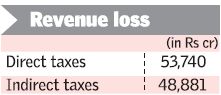
An internal assessment of the Finance Ministry has estimated that the country will forgo about Rs.90,000 crores in direct and indirect taxes over the next four years because of the SEZs across the country.

A large part of this loss is because export units that are now paying tax will shift to these areas ("Why the SEZ policy needs a rethink", The Hindu Business Line, May 26). Many wonder whether the pipedreams will actually translate into large-scale investment or is it just a real estate grab? The SEZ model is now being questioned even in China because it creates huge economic disparities rather than broad-based development.

That is the brand of `progress' that the people of Chirner are also challenging. "Our vegetables and fruits get the best price in the market. Why should we sell our land?" asks Kharpatil. "We fought the British. Now we will fight our own government." Chirner village is preparing for round two.

Link

Wednesday, January 17, 2007

A question marked in red

Professor Sumit Sarkar, eminent historian expressed his concern on forcible land acquisition in the following article published in the Indian Express on January 9, 2007.


A question marked in red
Sumit Sakar


As a lifelong Leftist, I am deeply shocked by recent events in the countryside of West Bengal. On December 31, a group of us went to Singur, spent the whole day there, visited 4 out of the 5 most affected villages which border the land that has been taken over. We had conversations with at least 50-60 villagers. Almost all rushed to us and told us their complaints.

From this brief but not necessarily unrepresentative sample, three things became very clear, because of which the West Bengal government’s version cannot be accepted. One, the land, far from being infertile or mono-cropped, as has been stated repeatedly, is sextremely fertile and multi-cropped. We saw potatoes and vegetables already growing after the aman rice has been harvested, some of them actually planted behind the now fenced-in area which the peasants had lost. Two, there is no doubt that the vast bulk of the villagers we met are opposed to the take-over of land and most are refusing compensation. It should also be kept in mind that at best the consent of the registered landholders as well as sharecroppers is being taken. But agricultural production also involves sharecroppers who are not covered by Operation Barga since they have come in later, as well as agricultural labour. Under the government-announced scheme for compensation, such people are not being remembered.

Three, we found much evidence of force being employed, particularly on the nights of September 25 and December 2. We met many people — men and also a large number of women — who had been beaten up, their injuries still visible, including an 80 year old woman.

What the villagers repeatedly alleged was that along with the police, and it seems more than the police, party activists, whom the villagers call ‘cadres’ — which has sadly become a term of abuse — did the major part of the beating up. Clearly, the whole thing had been done without consultation, with very little transparency, and in a very undemocratic manner.

As for the official claims of land being mono-cropped, the Economic and Political Weekly in an editorial of December 23 has pointed out that the last land survey of the area was done in the 1970s which means that the records with the government are backdated. Surely there must be much more investigation on the ground and consultation with panchayats and other local bodies. No one, not even the government, has actually claimed that such consultation has taken place. It was done entirely from the top.

These mistakes, to put it mildly, are being repeated on a much bigger scale in the Nandigram region. This has become far more serious because a much greater area of land is being taken — with the same lack of transparency, absence of consent and massive brutality. Once again, one is hearing reports of CPM cadres engaged in an offensive against peasants. What is happening at Nandigram is a near civil war situation.

The West Bengal government seems determined to follow a particular path of development involving major concessions both to big capitalists like the Tatas and multinationals operating in SEZs. Yet the strange thing is that these, particularly the latter, are things which Left parties and groups as well as many others have been repeatedly and vehemently opposing. No less a person than the CPM General Secretary in the course of last week made 2-3 statements attacking SEZs. The CPM has been at the forefront of the struggles against such developments in other parts of the country.

Surely there must be a search, at least, for paths of development that could balance necessary industrial development with social concerns and transparency and democratic values. Is this SEZ model that implies massive displacement and distress really the only way? If the West Bengal government thinks so, then it also has to accept that the inevitable consequences are going to be a repetition of Nandigram across the state.

This is the price that will be paid by government, ordinary people as well as investors for this model of development.

Wednesday, January 10, 2007

SEZ: Policy for Plunder

SEZ: Policy for Plunder


Buddha and other state governments become crazy with special economic zone (SEZ). Mainstream media have been portraying SEZ as panacea for Indian economy. They claim that SEZ will bring up enormous job opportunities and in turn eradicate poverty.

We know in all over India for SEZs different state governments has been planning to acquire lakhs of acres of land, most of which is farmland. Naturally people do protest and place like Nandigram the people’s resistance becomes too difficult to crackdown even after bloodshed.

A section of intellectuals and middleclass believe that this resistance is due to the unawareness of people and SEZ can change the face of India. They oppose people’s resistance and for them whoever oppose SEZ and land acquisition is anti-development and their actual aim is to keep people poor.

Let’s consider the whole issue.

A policy was introduced on 1.4.2000 for setting up of Special Economic Zones (SEZ) in the country with a view to provide an internationally competitive and hassle free environment for exports (1). But, why it is ‘special’? It is special, because industries in SEZ will have some definite advantages. They will be under huge tax exemptions. And apart from production, within SEZ township could be built up. There will be full authority to provide services like water, electricity, security, restaurants, recreation centers etc. on commercial lines (1). That means government will do everything to secure their maximum profit. But, this will cost really high price. For a period of four years, 2006-07 to 2009-10, the total revenue loss due to tax exemption to SEZ will be more than 1 lakh crore (3). It simply means that we, the Indian people have to subsidize this much amount directly to these big companies who will develop SEZs and set up industries over there. It simply shows that government (state or central) encourages SEZs to protect the interest of big companies and corporations. Since, in the existing laws, they are bound to pay taxes (it is different issue, how much they actually pay) and there could have been nation wide protest if government changes these laws, they have just made a new policy on April 1, 2000 to keep big companies out of taxation. And this is what they call as SEZ.


Mainstream media and the advocates of SEZs argue that the boom of job opportunities in SEZs will actually compensate this revenue loss. Crores of job then eradicate poverty from India and at the end poor Indian people will be benefited.

Nowadays the advocates of globalization are talking too much about job opportunities. Cleverly what they hide is the fact that in industries there is an increasing trend of recruiting contractual labour workers. They are the main work force now. They don’t have any professional security and most of the cases extremely underpaid. They have to work more than eight hours a day. If it continues then how increasing job opportunities will help? It simply cannot be. If somebody has a job, but he earns the salary not enough to provide minimum calorie to his family then it doesn’t help.


In this context it is important to understand that companies make profit out of the labour. It is the essence of capitalist mode of production, in other word capitalist exploitation. In the initial stage of capitalism the wage of a labour was enough to sustain his family. The average profit was enough to satisfy the capitalists. But, capitalists cannot make profit unless they sell the commodities. That means capitalism needs market. As capitalism grows, due to its exploitation it excludes more and more people from its market, which in turn makes more and difficult to ensure the profit.

With time capitalism has been entered its moribund stage, the imperialism, where monopoly dominates; centralization of capital becomes the main trend. After Second World War it has been reached such a phase when it requires maximum profit.

Maximum profit means maximum exploitation. Thanks to imperialist exploitation (actually plunder) that most of the people of the world become so poor that they are actually excluded from imperialist market. So imperialism simply doesn’t care for them. Different mainstream parties, government and mainstream media as the faithful agent of imperialism, are only concerned how their “bosses” can ensure the maximum profit.

This is the reason they dare to advocate SEZs and acquisition of farmland fully knowing that it is nothing to do any good for common poor Indian people, who are marginalized in the imperialist market. They are so faithful to serve the interest of imperialism and their comprador big Indian capitalists that they even don’t feel ashamed to falsify the fact: SEZs and acquisition of land will eradicate poverty from India. . Actually it is absurd to protect the interest of both imperialism (and big comprador capitalists) and common people at the same time.

There are intellectuals who also support the stand of government. They have been trying their level best to make us believe that it is the way of development as exactly same thing had happened during the industrial revolution in Europe. Industrialization requires land, but finally who will be evicted can end up with better opportunity in industry.

These advocates of imperialist plunder use to forget that the stage of capitalism right now is absolutely different from the days of industrial revolution in Europe. In those days the law of capitalism was the “law of surplus value”; which means that although capitalists used to make profit, although it used to exploit, it used to give workers the wages sufficient to sustain his livelihood. In contrast, at the phase of total collapse of imperialism, when it is driven by the securing maximum profit, means maximum exploitation, it cannot assure the minimum calorie to the majority of population. Two contexts are qualitatively different. Today, even in western world, workers have been loosing their jobs, as for achieving maximum profit, big corporations outsource. Nothing could be more precious than maximum profit. But, those days were different during industrialization in Europe; monopoly had never been hard of, market was gradually increasing, capitalism was proliferating.

We cannot blindly extrapolate the experience of industrialization in Europe in today’s India. In Europe what happened was the development of capitalism, whereas in India in the name of industrialization government has been allowing big companies and corporation to secure maximum profit, in other words maximum exploitation. The difference will be clear if we consider the role of feudalism in two cases. In Europe the feudal system was destroyed and it supplied the workforce in industries. In India, totally opposite happens. As more and more imperialist capital comes, semi-feudal relations strengthen. For instances, this companies hire workers from labour supply agencies. What is the role of these agencies? Their role is not better than as feudal lord. There are so many private big banks operating in India. They use to give loans and at the same time keep bunch of goons to get the monthly interest back at right time.

What does it indicate? So called industrialization, foreign investment doesn’t change the semi-feudal relations nowadays. The capitalism played a progressive role in history against feudalism. But, those days were gone century before when capitalism entered the stage of imperialism. Imperialism for its own existence now depends upon feudal relations in colonies and neo-colonies. In SEZs, there will be also full freedom for subcontracting including subcontracting abroad (2).


The model, which is being proposed with the name of SEZ, is therefore absolutely different from industrialization. What is going on is imperialist plunder at its highest level.

SEZ is to secure maximum profit to the big companies, not the minimum calorie to every Indian.


Note:
1.Facilities For Developers (http://www.sezindia.nic.in/fecilities_incentives.asp)

Developer of SEZ may import/procure goods without payment of duty for the development, operation and maintenance of SEZ.


Income tax exemption for a block of 10 year in 15 years at the option of developer as per section 80-IA of the Income Tax Act read with Appendix 14-II-N of Handbook of Procedure.

Full freedom in allocation of developed plots to approved SEZ units on purely commercial basis.

Full authority to provide services like water, electricity, security, restaurants, recreation centers etc. on commercial lines.

Foreign investment permitted to develop township within the SEZ with residential areas, markets, play grounds, clubs, recreation centers etc.

Develop Standard Design Factory (SDF) building in exiting Special Economic Zones. Guildlines at Appendix 14-II-N

Income Tax exemption to Investor's in SEZ's under section 10 (23) G of Income Tax Act.

Exemption from Service Tax

Investment made by individuals etc. in SEZ company also eligible for exemption u/s 88 of IT Act.

Development promoted to transfer infrastructure facility for operations and maintenance u/s 80-I-A of IT Act

Generation, Transmission and Distribution of Power in SEZs allowed.

2. Indian SEZ - Salient Features and Facilities (http://www.sezindia.nic.in/facilities_enterprise.asp)
A designated duty free enclave and to be treated as foreign territory for trade operations and duties and tariffs.

No licence required for import.

Exemption from customs duty on import of capital goods, raw materials,consumables, spares etc.

Exemption from Central Excise duty on procurement of capital goods, raw materials, consumable spares etc. from the domestic market.

Supplies from DTA to SEZ units treated as deemed exports.

Reimbursement of Central Sales Tax paid on domestic purchases.

100% income tax exemption for a block of five years,50% tax exemptions for two years and upto 50% of the Profits ploughed back for next 3 years under section 10-A of Income tax Act.

Supplies from DTA to SEZ to be treated as exports under 80HHC of the IT Act.

Carry forward of losses

100% Income-tax exemption for 3 years & 50% for 2 years under section 80-LA of the Income-tax Act for off-shore banking units.

Reimbursement of duty paid on furnace oil, procured from domestic oil companies to SEZ units as per the rate of Drawback notified by the Directorate General of Foreign Trade.

SEZ units may be for manufacturing, trading or service activity.

SEZ unit to be positive net foreign exchange earner within three years.

Performance of the units to be monitored by a Committee headed by Development Commissioner and consisting of Customs.

100% Foreign Direct Investment in manufacturing, sector allowed through automatic route barring a few sectors.

Facility to retain 100% foreign exchange receipts in EEFC Account.

Facility to realize and repatriate export proceeds within 12 months.

Re-export imported goods found defective, goods imported from foreign suppliers on loan basis etc. without G.R. Waiver under intimation to the Development Commissioner.

"Write-off" of unrealised export bills upto 5%.

Commodity hedging by SEZ units permitted

Capitilization of import payables

No cap on foreign investment for SSI reserved items.

Exemption from industrial licensing requirement for items reserved for SSI sector.

Profits allowed to be repatriated freely without any dividend balancing requirement.

Domestic Sales on full duty subject to import policy in force.

No fixed wastage norms.

Full freedom for subcontracting including subcontracting abroad.

Subcontracting facility available to jewellery units

Duty free goods to be utilized in 5 years.

Job work on behalf of domestic exporters for direct export allowed.

No routine examination by Customs of export and import cargo.

No separate documentation required for customs and Exim Policy.

In house customs Clearance.

Support services like banking, post office clearing agents etc. provided in Zone Complex.

Developed plots and ready to use built up space

Exemption from Custom/Excise Duty on goods for setting up units in the zone.

3. "The estimated revenue loss from tax concessions to Special Economic Zones (SEZ) to over Rs 1 lakh crore for the period 2006-07 to 2009-10." Mr. S. S. Palanimanickam, Minister of State of Finance through a written reply in parliament on Nov 24, 06.

Thursday, January 4, 2007

Headline Singur

This article was published in www.countercurrents.org on Dec 30, 06.

Headline Singur

By Amitadyuti Kumar

30 December, 2006
Countercurrents.org

It was the 3rd week of May, 2006 – the 18th day to be exact. The Left Front Government was sworn in for the 7th time in a row. Almost immediately Singur, an otherwise non-descript rural area in the Hooghly District, suddenly made the headlines. On that afternoon, the Chief Minister Mr. Buddhadeb Bhattacharyee, sitting alongside Mr Ratan Tata, the chief of a dominant Indian capitalist group - the TATA’s, announced in a press conference that Tata Motors had made an agreement with the state government to set up a factory for small cars at Singur. In the press conference it was also made public that the state government would hand over 1000 acres of land in Singur. It cleverly remained silent on whether any Memorandum of Understanding (MOU) had been signed.

Towards the evening the news spread in Singur and so did the people’s anger. The next day marked the beginning of public outrage. It did not wait for any organizational strength, political leadership. The fear of unemployment and starvation was so palpable that it broke all the barriers of age, gender and what’s more their political identities. It is not the first time that farmers’ land is taken away. Haldia, Bakreshwar or Rajarhat have their own sordid tales of how the government had given away their land to the industrialists or promoters, all in the name of development and industrialization. There were resentments and protests in those areas too. But the administration strengthened by the muscle power of the ruling party CPI (M) chose to ignore the popular sentiment. Protest and opposition in Singur assumed a different dimension, and because it assumed a different dimension, Singur could find a place in the media, if not hitting the headlines. Even the ruling CPM organ the Ganashakti had to find place for two to three news item/ commentaries a day without exception for the last seven months--- because while struggling for their right to life and a dignified livelihood Singur people has brought to the fore certain basic and important issues regarding development-industralsation-urbanisation and the eventual eviction and destruction of farmland. The more the issues were raised and in-depth discussions and debates went on, the more the government, the ruling party and their leaders took refuge in more and more lies and deceptions. The movement of the people of Singur for their right to life and farmland no longer remained the struggle of Singur people alone. It gave rise to more serious questions about the efficacy of development projects that keep 96% of the population of the area outside its ambit. The intelligentsia, economists politicians and sociologists came forward to find solutions of such riddles and have tried to deal with the issues. Their overwhelming opinions supported by facts and figures, expert opinions, and past experiences in home and abroad conclusively point to the fact that the government is erring. It has triggered off a whole lot of questions like whether it is a car manufacturing unit (or for that matter a liquor shop per thousand population or ultramodern housing projects) that West Bengal primarily needs at the moment for development. Questions are raised whether such projects are necessary to solve its basic problem of industrial stagnation and unemployment? If that be so, then by whom, when and on what basis has this approach been decided upon? Questions were also raised about how to select the land necessary for industrialization, about the long term as well as immediate effects on environment as a result of conversion of farmland to industrial plot, whether alternative sites can be found without disturbing agricultural land and so on. Comparisons are made to find out whether there will be any real employment generation if industries are set up on agricultural land. People became concerned about the future of those who are going to loss the roofs over their heads and their daily bread, whether justice is being meted out to them or not. The imminent uncertainty in the availability of food and the likely food crisis resulting from wanton destruction of farmland are also making people concerned.

Singur

‘Singur’ is a name new to the present day political workers. The railway routes of Howrah-Barddhaman Chord Line and Howrah-Tarakeswar branch make a perfect cross at Singur. A few decades ago, the area remained mostly inundated during rainy season by the two overflowing rivulets, the Kanakunti, the Zulkia, and the discharge from DVC dams. The last 24 years have seen the execution of only half of the planned Ghia-Kunti Drainage Scheme under the Lower Damodar Basin project. This alone has substantially reduced the fury of flood. Three major national highways run through or by Singur area. Bowbazar and Sheoraphuli Hat, the two of the biggest wholesale South Bengal markets for fruits and vegetables are in the range of 8/10 kms. The famous Ratanpur potato market is in Singur. One of the biggest Multipurpose Cold storages of the state, meant for storing vegetables as well as potato is situated in the area.

As the fury of flood has been tamed to a certain extent, the farmers have been making a modest earning thanks to the harmonious blend of fertile loamy soil and labour. Besides paddy and jute, potato and vegetables are the main cash crops here. Even the young graduates or the masters of these poor and the middle class families have engaged themselves in farming once the prospect of getting a service proves to be an illusion.

Because of improved farming techniques, application of fertilizers and pesticides, Singur two-thirds of Singur flood plain has by and large become a multi-crop land.

According to the statistics provided in a state government booklet (Krishi Upakaran Byabsayee Sahaika--Handbook for Agricultural Input Dealers, published by the Singur Block Agricultural Development Department in 2005), the block uses a whopping 10, 001 metric tonnes of fertilisers and 3061.5 metric tonnes of insecticides and other plant medicines every year. To cater the needs there are 303 agricultural inputs trading centers in the Block, whose 83% (8830 Hectares out of 10,526 Hectares agricultural land) is irrigated. The crop density of the Block is 220%, a step higher than the district average of 215%

Singur and its surroundings have a glorious past in peasant movement and democratic movements. The names of Dubir Bheri, Bara-Kamalapur and other villages are gloriously mentioned in the annuls of the famous tebhaga movement of the 1949-52 period. Late Dulal Ray, the noted Tarja Singer immortalized the heroic struggle of the legendary five women and other tebhaga movement activists.

Why Singur?

This is the Singur that the Government chose for Tata’s small car project, About 27% of the five mouzas (out of 16) of the Block has been finally selected ‘acquired’ and fenced off with a massive police action for the purpose. The process of selection of the site is quite unprecedented and queer. From the statements of the Chief Minister, only this much could be ascertained that the Tatas opted for it and the government accepted readily. Even as late as on 26 December, the CM was reported to have said that the government had no option but to accept Tatas’ proposal. The Government’s avowed policy is to consult with the affected and local people on all programmes of development. The 74th Constitutional amendment also calls for such consultations. There was not a semblance of a consultation or a discussion. The people first learnt from the media that the plots of land that has sustained them generations after generations, despite odds of floods and draughts were going to be taken away by the government. These are the plots of land around which they have weaved the dreams of their future taking it for granted that these plots of land were going to be the only means for the future sustenance of their children who will not be able to find a better living in the scheme of development of the country. They could not believe their ears, when they first heard it. Presently a small plot of land of as little as 5 cottas can encourage a sharecropper to send his kids to school nourishing an aspiration for a better future--this is going to be grabbed in the next couple of months. They could not believe their ears, when they first heard. Not only the people going to be affected, even the functionaries of the local government viz., BDO, the head of the Panchayet and even the local CPI (M) bosses were kept in dark too. But the laws of the land, the declared state policy all say in unison that all projects should be planned at the grass roots that are at Panchayet level. One can not but wonders—what are the compulsions that leave the government without any option but to accept Tatas’ proposal?

Avijit Mukherjee, the BDO of the block said—it is Singur because the official records show this area is marked as ‘single-cropped’, non-irrigated or ‘barren’. These records were based on surveys dating back to 1990. During the last 15 years, in the proposed Tata Motors site, the peasants have got installed 35 shallow pumps, 28 of which with their own money. In addition, there are three deep-tube wells. The two rivulets, the Zulkia and the Kunti – flowing along the either sides provide a substantial irrigational facility. In the dry season these rivulets and the DVC (Damodar Valley Corporation’s dams) release irrigate the fields. How can such land be called single-cropped, barren or non-irrigated? Even a lay man is aware that a single crop land in this part of Bengal means that the land has no irrigational facility; only the rain dependant cultivation is possible.

A blatant lie

The farmers made appeal before the government pointing to the mischief n Government records; they took part in demonstration against the DM to highlight the incorrect records. It was expected that the government would relent once the truth is known. But the Chief Minister made his stand clear. The Tata’s have asked for that particular land, and that’s final. The Government, the Industry Minister, the Land Minister only echoed their leader’s view. Even Sm Brinda Karat the non-resident Member of the Rajya Sabha from West Bengal repeated this lie in her dispatch n CPM organs and the internet. The statistics cited earlier in this dispatch quoting state government sources, the fact that the whole Singur block has an average crop density of 220% and the fact that the proposed Tata Motors site is most well irrigated and the most fertile in the block and scores of photographs and video clippings in the print and electronic media showing the fields of the area nails her lies. Here is a tale told by the Singur BDO in presence of the local Panchayet boss Ranjt Mandal recorded on 15 June--Singur is a 40 minutes’ drive from the airport along the newly built Expressway via the new Vivekananda Setu under construction. So the Tatas or their top brass flying from other metros will have to waste little time to reach their destination. Whoever expected to hear such a far-fetched excuse and that too from an avowedly pro-poor government and it comes at the expense of a 15000-strong agricultural work-force!

This control of the industrialists over the government, this ‘as you said sir’ attitude of the government is potentially dangerous for democracy and democratic values. The question naturally arose--is the government being run by the Tatas or for that matter other industrialists and capitalists? The government’s helpless and repeated admission that it has no option but to accept Tatas’ proposal, and the fact that the proposal of Tata Motors small car project was not discussed, approved or not even heard of in any discussion regarding the government’s industrial policy or any other forum or a constitutional body before the fateful day of swearing in of 7th LF government, hints at the danger and dark days ahead for democracy. Reagan regime in the US diverted Govt resources for the benefit of the industrialists who were facing serious challenges from Japan; Clinton’s rule saw to it that the oil giants consolidate their hold on the Government and state machinery. This hold in turn drove US under Bush administration to invade and occupy Iraq or Afghanistan, violate the civil and democratic rights of the US citizens or to go against civilization, Noam Chomsky has shown in ‘Propaganda and the Public Mind’.

The issues relating to the right to livelihood or to the share of the fruits of the ‘development’, or the government’s surrender to the industrialists, food security and a host of related issues churned the political atmosphere of the state. Singur catalysed the building up of a united opposition against all similar projects—from Nandigram and Haripur in Midnapore to Bhangar and Baruipur in the North 24 Parganas. A considerable section of Rights activities and social organizations sided with the people of Singur. At the start of the movement and till late October, barring a few, the intelligentsia and the Buddha sycophants took refuge under an absolute silence. The developments of the next couple of month almost completely polarized the political opinion of the parties and the individuals. Sadly, the CPI (M), to be specific the ruling clique of the CPI (M) along with a handful of powerful bureaucrats is on one side. Thus the post 18th May 2006 Singur is now a name of a completely different significance n the state, whose repercussions are now felt in the National scenario.

Some facts and figures

The WB Land & Land Reforms Minister had gone on record to say in the state assembly that about 1.20 acres of farmland has become casualty in the government’s ‘urbanization’ and industrialisation programmes in the last five years. He declared further that in the next 5 years, the government is going to transfer another 1 lakh acre or more farmland to the industrialists and promoters – for the sake of industrialization and urbanization. He did not conceal his concern for a resultant food-crisis on the floor of the House. The state agricultural minister was of the same view. But the big brother CPM and the senior cabinet members ruled out the possibility of any food crisis. The dissenting ministers had to fall in line. They parroted the rhetoric that Bengal is self-sufficient in food and leads in agricultural production. So it’s the time to use farmland for industry.

Whether West Bengal is Self-sufficient in Food Production?

As per the latest figures available from the Bureau of Applied Economics and Statistics of the West Bengal Government, the availability of food grains (considering both the domestic production and imports) is 177 kg per head per year for the period year 2001-05. According to the Planning Commission an adult requires an intake of 193 kg of food grains for subsistence. It is to be kept in mind that in those aforesaid years, there was no significant loss of food grains because of flood, draught or natural disaster. Despite this, the state faces a shortage of food grains @ 16 kg per head per year that is, approx 16 million tonnes (assuming the state population to be around 10 cores). This crisis would worsen by a further 10% if the next 5 years see shrinkage of another 1 lakh acre of farmland. This will totally upset the somewhat self sufficiency achieved in food grains and will totally jeopardize any prospect to achieve food self sufficiency and hamper food security of the people of lower income groups and the poor. This will lengthen the lines of starvation deaths-from Amlasole to Jalangi and elsewhere. According to latest National Sample Survey data (NSS Report No. 471), 15% of the state’s population can avail less than 70% of required daily calorie intake (2700 Cal per day) and.64% of them gets less than the required amount. In terms of daily intake West Bengal lags behind six states including Bihar and Orisa. According to a state government publication (Advancement in Agriculture: History of Success—Krishir Agragati—Dharabahik Saphalyer Itibritta) monthly per capita intake of food grains in the state fell to 13.27 Kg in 1993-94 (latest available data) from 15.25 Kg in 1972-73.

According to the findings of the UN Special Rapporteur on the Right to Food, Jean Ziegler, who presented his report on Extent of Chronic Hunger and Malnutrition in India before the UN Human Rights Council in Geneva on 22 September, 2006, food grain availability in rural India has fall to 152 kg per capita, 23 kg less than in the 1990s. Ziegler’s report was based on his visit to India from August 20 to September 2, 2005,”motivated by the fact that India has the largest number of undernourished people in the world and one of the highest levels of child malnutrition”. The report, which reviews “the situation of hunger, malnutrition and food insecurity in India” and whether the theory of “hunger amidst plenty” stands, has made some startling revelations. He observed that falling agricultural wages, increasing landlessness and rising food prices have severely undermined the right to food. Over half of India’s women and children are suffering from severe malnutrition and chronic undernourishment. Over 47 percent children are underweight and 46 percent stunted in their growth figures higher than most countries in poverty stricken sub-Saharan Africa. The poorest 30 percent of households eat less than 1700 kilocalories per day per person, well below the international minimum standard of 2100 kilocalories per day, even if they spend 70 percent of their income on food. (Times of India 24 September, 2006)

But this is what the masters of the world, the imperialists long for. Food deficiency will necessitate import and that is not so easy. The global food market is controlled by a handful of transnational food cartels. By virtue of the prevailing system of ‘forward trading’ these cartels are already the owners of the food grains that are to be produced in the next few years. No doubt import will depend on their sweet will and we will have no option but to agree to their terms and rates. One may not be totally wrong to read that Tata’s motor car at Singur is not a sudden, isolated and ill-conceived decision, rather a part of a larger conspiracy of neocolonialism.

Have West Bengal reached ultimate level of agricultural productivity?

The pre Budget Economic Survey 2004-05 of the state and a lavishly produced booklet (Advancement in Agriculture: History of Success—Krishir Agragati:Dharabahik Saphalyer Itibritta) show that in per Hectare paddy yield West Bengal (2463 Kg/Hectare) lags behind four other states including Andhra (2621 Kg/Hectare) Punjab (3510 Kg/Hectare) and Haryana (2724 Kg/Hectare). In wheat per Hectare yield in WB (2755 Kg) is about half that of Punjab (4696 Kg). One of the major reasons of low productivity is lack of irrigation. About 60% of agricultural land in West Bengal is still out of reach of any irrigational facility. The above booklet admits that irrigational facilities in WB is meager in comparison with other states

The above figures alone are indicative of the falsehood of claims like WB has reached the ultimate level of food productivity or development of agriculture is complete in the state. One of the factors affecting agricultural productivity is the level of land reform. The land reform programmes in the state have been abandoned midway Accordng to official statistics, during the 30 years of LF rule only 7% of land could be transferred to the actual peasants.

Is it not possible to build a factory at an alternative non-agricultural site in WB?

The ministers, industrialists, and their political parties keep on saying that industrialization is not possible in this state without using agricultural land. Without industrialization, development will just be a distant dream. So destruction of farmland is a must for W Bengal’s progress. Do the facts say so? The latest edition (2004) of the Statistical Handbook of the Government of WB reveals the following:

Total land area excluding Kolkata Metropolitan District:
8687521 Hectares

Area not available for Cultivation 1636038 Hectares

Net Sown Area 5427672 Hectares

Current fallows 333372 Hectares

Other Uncultivable land excluding Current fallows
119146 Hectares

Forest Area
1171293 Hectares

Those who travel across the state know it well that not only Bankura, Purulia, Midnapore, but the entire North Bengal too is provided with thousands of acres of barren and uncultivable land. As per the adopted policy of the centre and what’s more, the view of the five left parties expressed in their memorandum before the Centre on 6 October 2006 is that no agricultural land should be used for SEZs.

This apart, West Bengal has the distinction of its cities and urban areas being adorned by the rusting dilapipated sheds of thousands of closed factories – official figures alone put it at 65000. 40000 acres of prime industrial land is kept locked there for decades. The CPI (M) MP Santashri Chatterjee and the President of the Hooghly District CITU submitted a memorandum to the District Magistrate demanding use of such premises for setting up of new industrial units. The memorandum also mentioned that the Birlas were given 744 acres at the Hind Motors at throw away prices for setting up the Hindusthan Motors n 1948. The factory, which once employed 22,000 workers, used only 252 acres of the land given. The rest, about 500 acres was lying unused for the last 58 years. The memorandum suggested that this land can be used for industrialization. In an article in the CPI (M) daily Ganashakti, he reiterated the same demands. The government replied late next month. The state cabinet cleared the land for use by the Birlas for an IT park, thus enriching the Birla coffers by at least 1500 crores in one stroke. If the premises of closed Beni Engineering in Kolkata can be unlocked (though illegally) for real estate business, why could the 500 acres of land, kept unused for the last 58 years, at Hindmotors not be used for the purpose of a new industry?

Trade (or State?) secret – a white lie?

Even seven months after the movement started or three months after completion of ‘land acquisition’ process as claimed by the administration, no body knows whether the Tatas have paid the price for the land as per rules or whether the land is being forcibly ‘acquired’ from the poor peasants at the tax-payers expense to make a gift to the ‘Left-friend’ Tatas? The Land Acquisition Act 1894 and the procedures lad down to implement the act requires that the requiring authority (here the Tatas) must deposit the full cost of the land before acquisition procedures begin. After several enquires under RTI act 2005, in all the concerned Government Departments as to whether the Tatas have deposited any amount towards the cost of the land, the West Bengal Industrial Development Corporation, in its letter No Adm/141/2006/3113, dated 4 Dec., 2006 replied that ‘disclosure of information sought cannot be allowed under section 8(d) of the RTI Act 2005’. This section does not allow disclosure if the competitive position of a third party is harmed and unless it is necessary for greater public interest.

All major aspects of the proposed project have been kept under wraps. No body, even the cabinet ministers and left front partners know whether a MOU (Memorandum of Understanding) had been signed, or what are the understandings or agreements between the Government and the Tatas. Senior cabinet ministers belonging to non CPI (M) parties publicly aired their grievances for keeping them in the dark. All enquiries in this regard also faced the same black stone wall of secrecy. A similar formal exercise as above to illicit information on whether any MOU was reached with the company on the project and if so, a copy of the MOU, if no, a copy or the salient points of the draft of such MOU being discussed was carried out. The only reply to these queries was that ‘disclosure of information sought cannot be allowed under section 8(d) of the RTI Act 2005’.

A similar stonewall of secrecy is built around the incentives offered to the Tatas. Newspaper reports quoting ‘reliable sources’ suggest that the monetary value of the incentives offered to the Tatas for their Rs 1000 Crores investment may run up to 1500 Crores, if the cost of land, infrastructure and concessions are taken into account. Perhaps it is needless to say again that the governments reply to the queries on incentives under the West Bengal Incentive Scheme 2004 (No. 134 CI/O/Incentive/17/03/1 dated 24 March, 2004) or under any other scheme/proposal claimed by the Tata Motors for the project, offered/agreed to be offered by the government to the Tata Motors for the project, proposals/claims for incentives under consideration of the WBIDC or any other Government agency, received the same reply citing section 8(d) of the RTI Act 2005’.

It is strange that the Government is makng deals with a profit making concern at the cost of tax payers’ expense and nobody has the right to know anything. This attitude makes mockery of all principles of transparency and the Left Fronts commitment to ‘do everything by informing people beforehand and with their concurrence.’

Fighting Unemployment?

From all available information including Tata Motors press releases, it transpires that 800-odd employments may be generated initially which may go up to 2000 if and when the company attains the full production capacity of 5,00,000 cars per year. Even conservative estimates suggest that about 15000 people including sharecroppers, agricultural labourers, and small farmers artisans are going to be evicted from their profession. Among them are those, who do not own the agricultural land or water bodies but still make a living out of them, those who earn their living as trolley pullers, collies, fertilizer and other agricultural input dealers and their employees etc. How creating employment for 2000 over the years by immediately ousting 15000 from their livelihood may help in fighting unemployment is anybody’s guess. The tale of ancillary industries was proved to be a fairy-tale in case of Haldia. And 800 employments at the cost of 100 crores nvestments (plus state incentives valued at around 1500 crores) That means ten million crores investment (plus incentives from state exchequer) for 80 lakh registered unemployeds. It is beyond even any lunatics imagination !

The state government has no rehabilitation policy. A study shows that only 9% of those evicted during the post 1950 period got some sort of relief, however meager may it be. No body knows how the evictees will be rehabilitated or compensated. The government dubs the whole process as ‘trade secret’ to seek a safe escape route. Or sometimes, pretends to be a little bit more transparent –‘will be told in the appropriate time.’ A common sense suggests that there are other hidden agenda behind all these exercises declaredly for the benefit of ‘ignorant idiotic masses’. The spontaneous opposition to the machinations and its rapid spread show that the government has erred in assuming people’s concurrence for granted.

Meanwhile 200 people staging a peaceful demonstration were wounded in the police lathicharge 25 September. Rajkumar Bhul, a 24 year old agitator succumbed to the injures sustained during the police attack. About a hundred including 28 women were been arrested. Many were molested by the drunken police force. The prosecution admitted that barring some womenfolk who were carrying brooms in their hands as symbols for their resolve to broom out the Tatas, none have any weapon or any other thing. The seizure list mentioned seizure of 10 brooms apart from their festoon. Yet the hapless people were booked under sections of Explosive Act and on charges of attempt to murder (under sec 307 IPC). This is in line with the state government’s policy of persecution of all opposition and to ensure that these poor people rot behind the bars or harassed by the police or in the courts before they could be proved innocent. Thus the government will get the precious requisite time to hand over their land to the Tatas.

In the mean time, Medha Patkar, Maheshweta Devi, Chief Justice (Retd) Mr Malay Sengupta and many others came to hear those wretched people. The almost universal reaction of all those who visited the people of the area is that the government had made a heinous crime. They had to be vocal against government’s lies. Their first hand experience compelled them to take up the cause of the people of Singur. These have boosted the charged morale of Singur, their womenfolk included. It would be baffling to find how almost 100 percent women could become active participant in this movement. It is for the sociologists or the political organizers to answer. No doubt highly offensive suggestions by prominent CPM leaders like Polit Bureau nominee Benoy Konar and Nirupam Sen or local leaders like Balai Sabui to seek ‘better alternative living of mad servants in the houses of babus to be have added salt to the injured pride of the women folk. Apart from that, can we ignore the yearning of a peasant mother to see her child pass the secondary examination? Can we ignore the sentiments of a mother who weaves her dreams over the land that can provide the requisite livelihood to her kids? The land was a guarantee against starvation, if they can work hard. But now overnight their dreams are shattered by the government’s policy. It was only natural that they would vent their anger, hatred or resentment on the government.

The struggle in Singur has already achieved initial victories. The government has to change the map no less than thrice. The offered land price had to be increased from average 2 lakhs/acre to 8 lakhs/acre. Party whips, administrative pressures, police action, turning the area into a virtual police barrack, promise for various sops could not move the unrelenting masses and all these failed to compel about 60 % of land owners to sign a ‘declaration of voluntarily agreeing to land acquisition.’ Under a cover of a massive police terror the lands with this season’s rich paddy harvest, variety of vegetables and germinating potato seedlings were fenced off on 2 December. Prohibitory orders under Sec 144 were promulgated and ruthless terrors by police-cadre combine were unleashed to compel the farmers to sign ‘declaration of voluntarily agreeing to land acquisition.’ Like in Manipur or Kashmir or West Midnapore rape has been used as a weapon to terrorise the women. Sixteen year old Tapasi Malik is the first victim of such rape and murder. Even Mamata Banerjee, who is an MP and enjoys highest category security, was manhandled to a degree of outraging modesty to prevent her from proceeding to Singur. Renowned Social activist Medha Patkar was twice prevented by applying force from meeting the attacked people. A directionless government could not decide what to do after arresting her on 2 December along with this correspondent and three others and the two police vehicles carrying the detained persons were made to make rounds on highways for more than two hours. The baffled administration had no idea about what to do and requested Medha to be a state guest, which she righteously rejected and squatted on the police jeep for the whole night, only to lead a demonstration next morning at the Chandernagore police station where the molested, wounded victims of police repression were kept detained.

To many observers, the greatest victory the Singur movement achieved is uniting people in a common issue cutting across party lines, ideology, gender and belief. The seven month long movement remained within the parameters of legalo-democratic forms and in the face of massive police repression showed a rare and resolute non violent determination. During the 29 years of Left rule, Singur appears to be the stiffest challenge, almost completely polarising the entire population and isolating CPI(M), to be more specific its top coterie as the lone crusader in support of the land grab—even the smaller allies of the Left Front have not endorsed the Government’s stand. The entire opposition viz., Congress, Trinamool, Marxists, Maoists, socialists all have assembled in a platform against this onslaught. On the one side, CPM, the Tatas and a few powerful local media. Behind the scenes, lie the greedy imperialists. And on the other side, there are the masses of Singur, bolstered by the presence of almost all the political parties barring CPM. After 2 December police attack on fencing off unwilling farmer’s lands, Mamata Banerjee is on indefinite fast. She too appears to be transformed by Singur to a more responsible leader To nail the government’s lies owners of more than 430 acres of fenced off land submitted copies of affidavits executed before magistrates to the governor declaring that they did not give their land and are unwilling to do so. Another large section submitted that they were coerced to sign ‘declaration of voluntarily agreeing to land acquisition.’ which they want to withdraw.

Singur is now at a crossroads. Will it be able to set an example before the people of West Bengal or India? Singur may or may not be victorious. But it has sent its message loud and clear to the rest of the country. It is that those who consider India or West Bengal as the safe haven for the imperialists or their followers will have to think again. Singur has already created waves in each and every place where the government expressed desire to acquire agricultural land. Singur fights, she fights whether we support them or not. But the real test is before us. Can we give the same do-or-die dimension to our fight for democracy, freedom or development? Will we be able to attract all the countrymen to rally for this fight?

Amitadyuti Kumar
Vice President,
Association for Protection of Democratic Rights (APDR)
Senpara, PO Burashibtala, Chinsura, Dist Hooghly, WB, INDIA

Link: www.countercurrents.org